


What Is a WPC Door Panel?
A WPC door panel is a door surface or complete door slab manufactured from Wood Plastic Composite — a hybrid material that combines wood fiber or wood flour with thermoplastic polymers such as PVC, polyethylene (PE), or polypropylene (PP), along with various chemical additives including stabilizers, foaming agents, UV inhibitors, and colorants. The resulting composite material is processed through an extrusion or molding process to produce door panels that visually resemble natural wood while delivering performance characteristics that solid wood and conventional MDF door panels cannot match — particularly in terms of moisture resistance, dimensional stability, and resistance to insects and rot.
WPC door panels have gained significant market traction across residential, commercial, and hospitality construction sectors over the past decade, driven by growing demand for building materials that combine the aesthetic warmth of wood with the practical durability of engineered composites. In regions with high humidity, heavy rainfall, or significant temperature variation — such as coastal areas, tropical climates, and regions with cold winters — WPC wood plastic composite door panels offer a compelling alternative to solid wood doors that warp, swell, and delaminate, and to hollow-core MDF doors that fail rapidly in wet environments. The material's versatility in surface finishing also means that WPC door panels can be produced in a wide range of wood-grain textures, solid colors, and gloss levels to suit virtually any interior design direction.
How WPC Door Panels Are Made
The manufacturing process for WPC door panels begins with the precise blending of raw material components in specific ratios that determine the final product's density, hardness, flexibility, and surface quality. The wood fiber content — typically wood flour, rice husk, bamboo fiber, or sawdust — is dried to a moisture content below 3% before blending to prevent steam formation during processing, which would create voids and surface defects. The dried wood fiber is then mixed with the polymer base (most commonly PVC for door panels due to its superior fire resistance and dimensional stability), stabilizers to prevent polymer degradation during processing, foaming agents to control density, impact modifiers to improve toughness, and pigments for coloring.
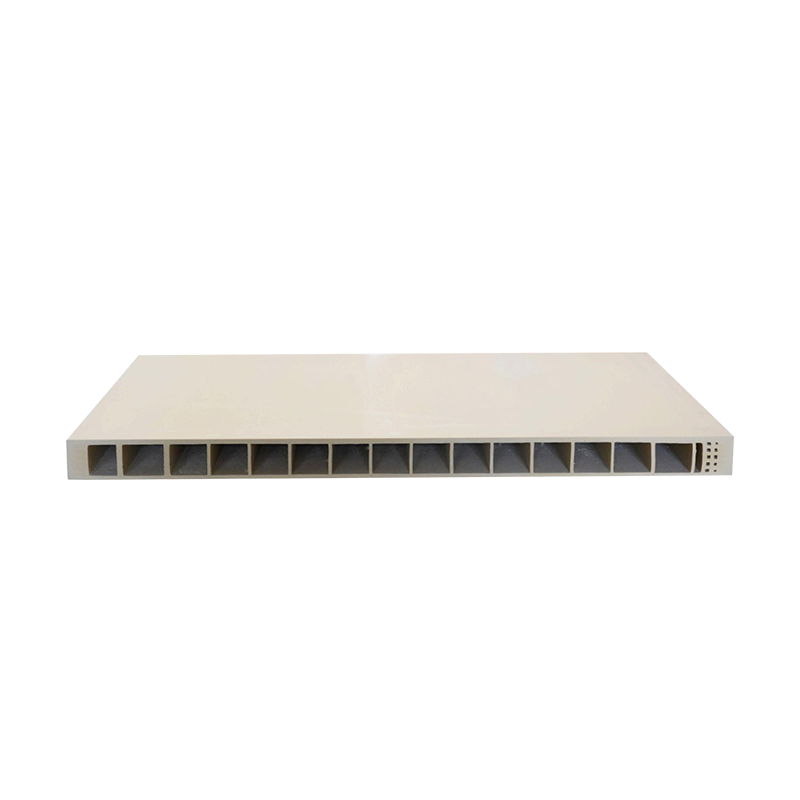
This blended compound is fed into a twin-screw extruder that melts and homogenizes the mixture under controlled temperature and pressure conditions before forcing it through a shaped die that determines the panel's cross-sectional profile. For WPC door panels, the extrusion die typically produces a cellular or hollow-core profile that reduces material use and overall door weight while maintaining structural rigidity through strategically placed internal ribs. The extruded profile is then calibrated to final dimensions in a vacuum calibration tank, cooled in a water cooling tank, and cut to length by a flying saw. The raw extruded surface is then processed through embossing rollers that apply the wood-grain texture, followed by surface coating or lamination with a decorative film, UV-curable paint, or PVC foil to achieve the final aesthetic finish.
Key Properties and Performance Advantages of WPC Door Panels
The combination of wood fiber and polymer in WPC door panels creates a material profile that addresses many of the most common failure modes of traditional door materials. Here is a detailed breakdown of the performance properties that make WPC door panels stand out:
Moisture and Water Resistance
The polymer matrix in a WPC door panel encapsulates the wood fiber particles, dramatically reducing the material's ability to absorb liquid water compared to solid wood or MDF. High-quality WPC door panels typically exhibit water absorption rates of less than 1–3% after 24-hour immersion testing, compared to 8–15% for standard MDF and 5–10% for untreated solid wood. This moisture resistance translates directly to dimensional stability — WPC door panels do not swell, warp, or delaminate when exposed to humidity fluctuations or direct water contact, making them suitable for bathroom doors, kitchen doors, laundry room applications, and exterior-facing interior doors in humid climates where conventional wood doors consistently fail within a few years.
Termite and Insect Resistance
Unlike solid wood doors, which are highly susceptible to termite damage in tropical and subtropical regions, WPC door panels are inherently resistant to termite and other insect infestation. The polymer component of the composite is not a food source for termites, and the encapsulation of wood fiber within the polymer matrix makes the wood fiber inaccessible to insects even if the surface is scratched or damaged. This property makes WPC wood composite door panels a preferred choice in regions of Southeast Asia, South Asia, Africa, and South America where termite damage to wood building components is a widespread and costly maintenance problem.
Dimensional Stability and Flatness
One of the most practically significant advantages of WPC door panels over solid wood is their resistance to warping, twisting, and cupping under thermal and humidity cycling. Solid wood doors are prone to seasonal movement as the wood grain expands and contracts with humidity changes, causing doors to stick in summer and rattle in winter, misalign with their frames, and develop gaps at the top or sides. WPC composite door panels have a much lower coefficient of hygroscopic expansion than solid wood and maintain their flat, straight geometry through temperature and humidity cycles that would cause significant distortion in natural timber, reducing installation callbacks and long-term maintenance requirements for builders and property managers.
Sound Insulation
WPC door panels with cellular internal structures provide meaningful acoustic insulation compared to hollow-core doors. The combination of the dense composite skin, cellular internal ribs, and enclosed air cells within the panel's cross-section creates a composite sound barrier that absorbs and reflects airborne sound energy. While WPC door panels do not achieve the acoustic performance of specialist solid-core acoustic doors, they perform significantly better than hollow-core HDF or MDF doors and are well-suited to bedroom, study, and office applications where basic sound privacy is required.
WPC Door Panel vs. Other Door Materials: A Practical Comparison
Understanding how WPC wood plastic composite door panels compare to the alternatives helps specifiers, contractors, and homeowners make the most appropriate material choice for each specific application. The table below provides a direct comparison across the most relevant selection criteria:
| Property | WPC Door Panel | Solid Wood Door | MDF/HDF Door | PVC Door |
| Moisture Resistance | Excellent | Poor–Moderate | Poor | Excellent |
| Termite Resistance | Excellent | Poor | Moderate | Excellent |
| Dimensional Stability | Excellent | Poor | Moderate | Good |
| Natural Wood Appearance | Good | Excellent | Good (with veneer) | Moderate |
| Screw and Hardware Holding | Good | Excellent | Moderate | Poor |
| Paintability and Finishing | Good | Excellent | Excellent | Limited |
| Fire Resistance | Good (PVC-based) | Poor | Moderate | Good |
| Relative Cost | Moderate | High | Low–Moderate | Low–Moderate |
| Lifespan (Interior Use) | 15–25+ years | 20–50+ years | 5–15 years | 10–20 years |
Types and Profiles of WPC Door Panels Available
The WPC door panel market offers a wide range of product types, structural profiles, and surface finish options to meet different application requirements, aesthetic preferences, and budget levels. Understanding the major product categories helps builders, interior designers, and procurement managers specify the right product for each project.
Solid WPC Door Panels
Solid WPC door panels are produced with a fully solid cross-section — no voids, cells, or hollow chambers — resulting in a heavy, dense product with maximum screw-holding strength, superior sound insulation, and the most rigid structural performance. Solid WPC composite door panels are used in high-traffic commercial applications, security-sensitive installations, and locations where maximum durability and impact resistance are required. Their higher material content makes them more expensive per panel than cellular alternatives, and their greater weight requires heavier-duty door hardware and more robust frame construction.
Cellular or Foam-Core WPC Door Panels
Cellular WPC door panels incorporate a foamed or hollow internal structure that significantly reduces the panel's weight and material cost compared to solid profiles while maintaining adequate structural rigidity for most interior door applications through the design of the internal rib geometry. These panels are the most widely used type in residential construction because they balance performance, weight, and cost effectively. The cellular structure also provides better thermal insulation than solid panels, which can be beneficial in doors separating conditioned and unconditioned spaces. The reduced weight of cellular WPC door panels also simplifies installation and is gentler on door frames and hinge hardware over the long term.
WPC Door Panels with Groove and Decorative Profiles
Many WPC door panel manufacturers offer products with routed or extruded decorative profiles on the face surface — including raised panels, recessed panels, V-groove patterns, and beaded designs — that create the visual appearance of traditional panel doors without the complexity and cost of manufacturing actual framed panel door construction. These profiled WPC door panels are popular in renovation projects where a period or traditional aesthetic is desired, and in hospitality and retail interior applications where a premium visual appearance is needed at a controlled cost. The profiles are either machined into the extruded surface after production or incorporated directly into the extrusion die design.
WPC Flush Door Panels
WPC flush door panels have a completely flat, smooth face surface with no raised or recessed profile features. They are the most commonly specified type for contemporary minimalist interiors, commercial office fitouts, and healthcare facilities where easy surface cleaning is a priority. Flush WPC door panels are available with a wide range of surface finishes including high-gloss PVC foil lamination, matte UV paint, woodgrain embossed film, and solid-color acrylic finishes. Their simple flat geometry also makes them the easiest type to paint on-site if color changes are required after installation.
Surface Finish Options for WPC Door Panels
The surface finish applied to a WPC door panel significantly affects its visual appearance, durability, cleanability, and suitability for different environments. Here are the main surface finish types available and their practical characteristics:
- PVC Film Lamination: A decorative PVC film printed with woodgrain, marble, solid color, or abstract patterns is thermally bonded to the WPC substrate surface. PVC film lamination is the most widely available and cost-effective surface finish option, offering excellent moisture resistance, good scratch resistance, and a wide range of visual options. It is available in both gloss and matte finishes and can closely replicate the appearance of various wood species, stone textures, and painted surfaces.
- UV-Cured Paint Finish: UV paint is applied to the WPC panel surface and immediately cured by ultraviolet light in a factory production line process. UV-finished WPC door panels have excellent hardness, chemical resistance, and color fastness. Matte, satin, and high-gloss UV finishes are available, and the factory application ensures more consistent quality than site-applied paint finishes.
- Acrylic High-Gloss Finish: A thick acrylic coating applied to the panel surface creates an extremely high-gloss, mirror-like finish that is popular in contemporary kitchen and bathroom door applications. Acrylic-finished WPC door panels have a premium visual appearance but are more susceptible to surface scratching than UV-paint or PVC film finishes and should be specified with care in high-traffic or commercial environments.
- Melamine Paper Overlay: Some WPC door panels are surfaced with melamine-impregnated decorative paper, similar to the surface material used on MDF-based panels. Melamine overlays provide a cost-effective, scratch-resistant surface in a wide range of woodgrain and solid color options and are commonly used in entry-level WPC door panel products for budget-conscious residential projects.
- Unfinished (Ready to Paint): Some WPC door panels are supplied with a primed or unfinished surface intended to be painted on-site. This option provides maximum color flexibility for builders and designers who want precise color matching to other elements of the interior scheme, and it allows for future repainting when the interior color scheme changes without requiring door replacement.
WPC Door Panel Standard Sizes and Customization
WPC door panels are manufactured in standard sizes that align with common architectural door dimensions used in residential and commercial construction. The table below lists typical standard sizes, though availability varies by manufacturer and regional market:
| Application | Standard Width | Standard Height | Standard Thickness |
| Bedroom Door | 800–900 mm | 2000–2100 mm | 35–40 mm |
| Bathroom / Toilet Door | 700–800 mm | 2000–2100 mm | 30–35 mm |
| Main Entrance Door | 900–1000 mm | 2100–2400 mm | 40–45 mm |
| Wardrobe / Sliding Door | 600–900 mm | 2000–2400 mm | 18–28 mm |
| Commercial / Office Door | 900–1000 mm | 2100–2700 mm | 40–50 mm |
Most WPC door panel manufacturers offer customization of panel dimensions for renovation projects with non-standard opening sizes, bespoke architectural specifications, and commercial projects requiring specific fire rating or acoustic performance dimensions. Custom orders typically require minimum order quantities and longer lead times than standard stock sizes, so early specification and procurement planning is advisable for projects with non-standard requirements.
Installation Guide for WPC Door Panels
WPC door panel installation follows a similar workflow to conventional door installation but with some specific considerations related to the material's properties and hardware requirements. Following the correct installation procedure ensures the door operates correctly, looks its best, and achieves its full performance lifespan.
Frame Preparation and Sizing
Begin by accurately measuring the door opening and confirming that the frame is plumb, level, and square. WPC door panels are significantly more dimensionally stable than solid wood, but the door frame itself must be correctly installed for the door to operate without binding or gaps. If the existing frame is out of square by more than 3 mm over its height or width, it should be corrected before hanging the door. Allow a clearance of 2–3 mm on each side and at the top of the door panel within the frame for thermal movement and smooth operation. At the bottom, allow clearance for the floor finish being used — typically 10–15 mm for carpeted floors and 5–8 mm for hard floors.
Hinge Selection and Installation
WPC door panels require quality steel or stainless steel hinges rated for the door's weight. For cellular WPC door panels, hinges should be installed at hinge locations that coincide with the internal ribs of the panel cross-section to ensure adequate screw pull-out strength — check the manufacturer's installation guide for rib location dimensions. Use the recommended screw length for WPC material; screws that are too short will pull out under the door's weight, and screws that are too long may penetrate through thin panel walls. Three hinges are recommended for all WPC door panels over 2100 mm in height or 40 kg in weight, with the middle hinge positioned at the midpoint between the top and bottom hinges.
Lock and Hardware Fitting
Lock cases, deadbolts, lever handles, and other door hardware can be fitted to WPC door panels using standard woodworking tools — hole saws, chisels, and routers all work effectively on WPC composite material. Unlike pure PVC doors, WPC panels have sufficient density and screw-holding strength to reliably retain standard door lock hardware without the need for reinforcing inserts in most cases. For heavy-duty commercial locks or multi-point locking systems, check that the lock's backset and case dimensions are compatible with the panel thickness, and confirm that the panel's internal rib structure provides solid material at the lock installation location.
Maintenance and Long-Term Care of WPC Door Panels
One of the most commercially attractive aspects of WPC wood plastic composite door panels is their minimal maintenance requirements compared to solid wood doors, which need periodic sanding, repainting, or re-staining to maintain their appearance and weather resistance. Here is the maintenance approach that keeps WPC door panels looking their best over the long term:
- Routine Cleaning: Clean WPC door panels with a soft cloth or sponge dampened with mild soapy water. Most surface finishes used on WPC panels — including PVC film lamination, UV paint, and acrylic coatings — are highly resistant to common household cleaning products. Avoid abrasive scrubbing pads, steel wool, or solvent-based cleaners such as acetone or paint thinner, which can scratch or dissolve surface coatings. For bathroom and kitchen doors subject to grease and soap residue buildup, a mild degreasing spray cleaner works effectively without damaging the panel surface.
- Scratch and Surface Damage Repair: Minor surface scratches on PVC film-laminated WPC door panels can sometimes be minimized using a color-matched furniture touch-up marker or wax crayon. For deeper scratches that expose the raw WPC substrate, apply a compatible primer followed by color-matched paint to prevent moisture penetration at the exposed edge. Unlike solid wood, WPC panels cannot be sanded and refinished over their full surface — if the decorative surface is extensively damaged, panel replacement is typically the most practical solution.
- Hardware Maintenance: Lubricate door hinges with a light machine oil or silicone spray every 12–18 months to prevent squeaking and corrosion. Check and tighten hinge screws annually, as vibration and repeated door movement can gradually loosen fasteners over time. Lubricate door lock mechanisms with graphite powder or a dry PTFE lubricant rather than oil-based products, which attract dust and grit that can cause lock mechanism wear.
- Edge Sealing: Although WPC door panels are inherently moisture resistant, the cut edges exposed during installation — particularly at the bottom of the door panel — should be sealed with a compatible edge sealant or silicone caulk in very wet environments such as bathrooms, laundry rooms, and exterior-facing applications. This sealing step prevents any water ingress at the cut edge over the long term and is a precaution worth taking on panels installed in areas subject to standing water or frequent floor washing.


